
When you look at vinyl plank flooring in 2026, you see prices that can change based on the product and where you live.
- The average retail price for vinyl plank flooring ranges from USD 3.50 to USD 5.00 per square foot. Some premium flooring can reach up to USD 7.00 per square foot.
- The installation cost for vinyl plank flooring falls between $4 and $13 per square foot.
If you want to know how much to charge to install vinyl plank flooring, you should consider these prices for your estimate. Accurate estimates help you plan your budget, avoid surprise costs, and choose the right flooring for your needs. When you understand the total cost, you make better decisions for your home or project.
Vinyl Plank Flooring Installation Cost Table
Average Price Per Square Foot in 2026
You need to know the average price per square foot for vinyl plank flooring installation before you start your project. In 2026, you can expect to pay between $4 and $13 per square foot for installation. This price includes labor and basic materials. The price depends on the type of flooring you choose and the complexity of the job. If you select premium vinyl plank flooring, the price can reach up to $7 per square foot for the material alone. You should always check the latest rates in your area because prices can change.
Here is a table that shows the typical installation price for vinyl plank flooring in Canada. You can use this as a reference for your own estimate.
| Flooring Type | Installation Price (CAD/sq.ft) |
|---|---|
| Vinyl Plank | $2.25 – $3.25 |
You may see higher prices in other regions. The cost of vinyl plank flooring installation can also increase if you need extra services like subfloor preparation or removal of old flooring.
Tip: Always ask for a detailed quote from your installer. This helps you understand what is included in the price and prevents unexpected costs.
Typical Charges by Room Size
You can estimate the cost by room size if you know the average price per square foot. This makes planning easier and helps you set a budget. Here are some common room sizes and their typical vinyl plank flooring installation costs in 2026:
- Small Bedroom (100 sq.ft):
- Installation cost: $400 – $1,300
- Medium Bedroom (150 sq.ft):
- Installation cost: $600 – $1,950
- Living Room (250 sq.ft):
- Installation cost: $1,000 – $3,250
- Large Area (500 sq.ft):
- Installation cost: $2,000 – $6,500
You can use these numbers to compare the cost by room. The cost of vinyl plank flooring installation changes with the size of the space. Larger rooms often have a lower price per square foot because installers can work faster. Smaller rooms may cost more per square foot because of extra cutting and fitting.
If you want to calculate the cost of vinyl plank flooring for your home, measure each room and multiply the area by the current installation rate. Add extra for waste and special features like stairs or complex layouts.
Note: The cost of vinyl plank flooring installation can rise if you need to move furniture or prepare the subfloor. Always include these factors in your estimate.
You can see that vinyl plank flooring installation offers flexibility for different budgets. You can choose basic or premium flooring and adjust your project to fit your needs. The cost of vinyl plank flooring installation depends on the size of your room, the type of flooring, and the services you require.
Factors Affecting the Cost of Vinyl Plank Flooring Installation
When you plan a vinyl plank flooring installation, you need to know what affects the final cost. Many things can change how much you pay for your new flooring. Here are the main factors you should consider:
- The size of your space matters. Larger rooms need more flooring and labor, which increases the cost.
- The layout of your room can make the job harder. Odd shapes or many corners mean more time and skill.
- The condition of your subfloor can add to the cost. If you need repairs or leveling, you will pay more.
- The type of vinyl plank flooring you choose changes the price. Some types need special tools or glue.
- Labor rates in your area can be higher or lower. More experienced installers may charge more.
- Extra materials like underlayment or trim also add to the total cost.
Type of Vinyl Plank Flooring
You have many choices for vinyl plank flooring. Each type has its own price and features. The table below shows how different types affect your cost:
| Type of Vinyl Tile | Material Cost (per sq.ft) | Installation Cost (per sq.ft) | Adhesive Cost (per sq.ft) | Features |
|---|---|---|---|---|
| Budget Vinyl Tile | $2.40 | $2.70 | $0.45 | 2mm thickness, basic patterns, 5-year warranty |
| Mid-Range Vinyl Tile | $3.40 | $3.90 | $0.60 | 3mm thickness, enhanced patterns, 10-year warranty |
| Premium Vinyl Tile | $4.40 | $5.20 | $0.75 | 4mm+ thickness, luxury patterns, 15-year warranty |
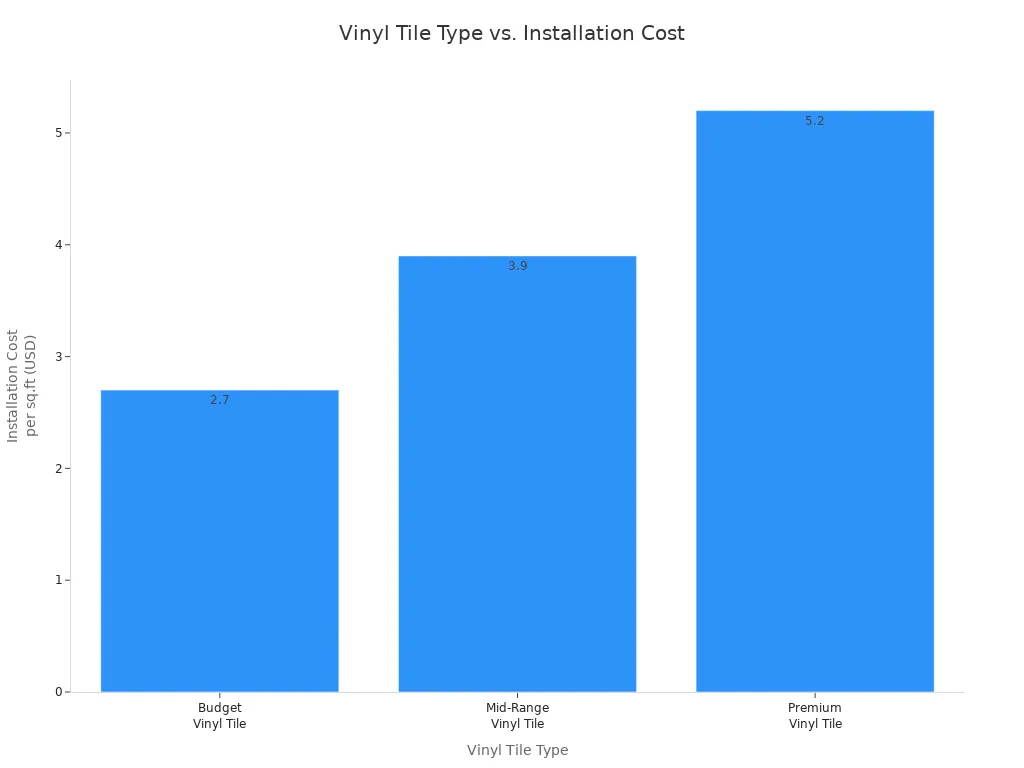
If you pick premium flooring, you get thicker planks and better designs. You also pay more for both materials and installation.
Labor Rates in 2026
Labor rates can change the cost of your vinyl plank flooring installation. In 2026, you may see higher prices in big cities or areas with high demand. Installers with more experience often charge more. You should always ask for a quote before you start your project.
Room Size and Layout
Room size and layout play a big role in your total cost. Large rooms need more flooring, which means you buy more material and pay for more labor. If your room has many corners, closets, or obstacles, the installer will need more time and skill. This can raise the price of your vinyl plank flooring installation.
Tip: Measure your room and check for tricky spots before you ask for a quote. This helps you get a fair estimate and avoid surprises.
Subfloor Condition
You need to check the subfloor before you start installing vinyl plank flooring. The subfloor sits under your flooring and supports it. If your subfloor is in good shape, you can install new flooring quickly. If the subfloor has damage or needs repairs, you will spend more time and money on your project.
Here is a table that shows how the condition of your subfloor can change the cost of your flooring installation:
| Subfloor Condition | Cost Impact (relative to Good Condition) |
|---|---|
| Good Condition | 1.0x |
| Needs Preparation | N/A |
| Damaged / Replace | 1.3x |
If your subfloor is in good condition, you pay the standard price for flooring installation. If you need to replace or repair the subfloor, your cost can go up by 30%. You may also need extra materials to fix the subfloor. Always ask your installer to check the subfloor before you start. This helps you avoid problems later.
Tip: A strong subfloor keeps your flooring flat and safe. Never skip this step.
Removal of Old Flooring
You may need to remove old flooring before you install new vinyl plank flooring. This step can add time and cost to your project. Removing old flooring means you must also move heavy furniture and clean up debris. These tasks take extra labor hours and increase the total cost.
- Removing old flooring adds to your labor costs.
- You may need to pay for debris disposal.
- Moving heavy furniture can slow down the work.
- If the subfloor needs repairs or leveling, you will pay more for labor and materials.
- Complex flooring removal jobs cost more because they take longer.
You should always include the cost of removing old flooring in your estimate. This helps you plan your budget and avoid surprises. Good planning makes your flooring project easier and faster.
How to Calculate How Much to Charge to Install Vinyl Plank Flooring
You want to set a fair price for your flooring work. You also want to make sure you cover all your costs and make a profit. To do this, you need to follow a few simple steps. This guide will help you figure out how much to charge to install vinyl plank flooring in any space.
Measuring Your Space
Start by measuring the area where you plan to install the flooring. Accurate measurements help you avoid running short on materials or overestimating your budget. Use a tape measure or a digital tool to get the length and width of each room. If your space has odd shapes or nooks, break it down into smaller sections. Add up the square footage for each part to get the total area.
Here are the best practices for measuring your space:
- Measure each wall and write down the numbers.
- Divide large rooms into smaller rectangles or squares for easier calculation.
- Include closets, alcoves, and any irregular spaces.
- Use digital apps or measuring tools for better accuracy.
- Double-check your numbers to avoid mistakes.
Tip: Careful measurement is the first step to accurate installation cost estimates. Mistakes here can lead to higher costs later.
Adding Waste Percentage
After you measure your space, you need to add extra material for waste. This covers mistakes, pattern matching, and cuts around corners. Most installers add 10% to the total square footage for standard rooms. For rooms with complex layouts, you may need to add up to 15%.
- Add 10% extra for regular rooms.
- Add up to 15% for rooms with many corners or angles.
- This extra material helps you avoid delays if you make a mistake or find a damaged plank.
For example, if your room measures 200 square feet, you should plan for 220 square feet of flooring for a standard layout. If the room has many angles, plan for 230 square feet.
Note: Ordering the right amount of flooring keeps your project on track and helps you stay within your budget.
Multiplying by Current Rate
Now you need to figure out how much to charge to install vinyl plank flooring based on your measurements and the current market rate. Multiply the total square footage (including waste) by the rate you charge per square foot. You can also use hourly rates if you prefer.
Here is a simple formula:
Total Cost = (Measured Square Footage + Waste) x Installation Rate per Square Foot
You can also use hourly rates for your calculation. For residential jobs, many installers charge about $65 per hour and spend around 16 hours on a typical project. This means you could charge about $1,040 for a standard residential job. For commercial jobs, the rate may be $75 per hour for about 32 hours, which totals $2,400. Always include extra services like subfloor prep or trim in your final price.
| Job Type | Rate (per hour) | Hours | Base Charge |
|---|---|---|---|
| Residential | $65 | 16 | $1,040 |
| Commercial | $75 | 32 | $2,400 |
Tip: Set clear service rates and review your estimate before giving it to your client. This helps you avoid errors and ensures you cover all your costs.
When you follow these steps, you can answer the question of how much to charge to install vinyl plank flooring with confidence. You will know your installation costs, material needs, and the right price for your work. This process helps you stay competitive and keeps your budget on track. Always review your numbers and adjust for any special features or extra work.
Labor vs. Material Costs for Vinyl Plank Flooring Installation
When you plan a vinyl plank flooring installation, you need to understand how labor and material costs work together. Knowing the difference helps you set a fair price and avoid surprises.
Labor Cost Breakdown
Labor costs cover the work needed to put your new flooring in place. In 2026, you can expect to pay between $1.50 and $6.00 per square foot for labor during a vinyl plank flooring installation. The price depends on the size of your space and how complex the job is. Some rooms have simple layouts, while others need more time because of corners or closets.
Labor charges often include these tasks:
- Measuring and planning the layout
- Cutting and fitting each plank
- Placing the flooring and securing it
- Cleaning up after the job
You may also face extra labor costs if you need to remove old flooring or prepare the subfloor. Removing carpet usually costs $0.50 to $1.50 per square foot. Taking out tile can cost $1.50 to $3.00 per square foot. If your subfloor needs leveling, you might pay $1.00 to $6.00 per square foot. These extra steps can add 25–40% to your total cost.
Material Cost Breakdown
Material costs include everything you need to complete your flooring project. This covers the vinyl planks, underlayment, adhesives, and trim pieces. The price for vinyl plank flooring ranges from $3.50 to $7.00 per square foot, depending on the quality and style you choose.
Here is a simple table to help you see the typical material costs:
| Material Type | Cost per sq.ft (USD) |
|---|---|
| Vinyl Planks | $3.50 – $7.00 |
| Underlayment | $0.50 – $1.00 |
| Adhesives/Trim | $0.50 – $1.00 |
You should always add a little extra for waste and mistakes. Good planning helps you avoid running out of flooring before the job is done. When you know both labor and material costs, you can make smart choices for your vinyl plank flooring installation.
Additional Costs and Considerations for Vinyl Plank Flooring Cost
Underlayment and Prep Work
You should always consider underlayment and prep work when planning your vinyl plank flooring project. Underlayment creates a smooth surface and helps with sound and moisture control. The cost for underlayment usually ranges from $0.50 to $1.00 per square foot. If your subfloor has issues like uneven slabs or moisture, you may need extra prep work. This can add $1.00 to $6.00 per square foot to your total cost. Sometimes, major repairs can reach up to $10 per square foot. These steps make sure your flooring lasts longer and looks better.
Here is a quick table to help you see the extra costs:
| Cost Component | Estimated Cost Range |
|---|---|
| Underlayment | $0.50 to $1.00 per square foot |
| Subfloor Preparation | $1 to $3 per square foot (up to $10 for major repairs) |
Tip: Always check your subfloor before starting. Good prep work prevents future problems with your flooring.
Moving Furniture
You need to move furniture before installing new flooring. Installers often charge $50 to $150 for this service. If you have heavy or many pieces, the cost may go up. Moving furniture helps the installers work faster and keeps your items safe. You can save money by moving smaller items yourself before the flooring team arrives.
Complex Layouts and Stairs
Complex room shapes and stairs can increase the cost of your vinyl plank flooring installation. Rooms with many corners or odd shapes require more cutting and fitting. Stairs add even more to the cost because they take extra time and skill. If your home has multiple levels, the installation process becomes more complicated. You should expect higher costs for these features.
Note: Always ask your installer about extra charges for stairs or complex layouts. Planning ahead helps you avoid surprises in your final flooring cost.
DIY vs. Professional Vinyl Plank Flooring Installation Cost
Cost Comparison
You might wonder if you should install your own vinyl plank flooring or hire a professional. The cost difference can be big. If you choose diy installation, you can save hundreds of dollars, especially in smaller rooms. You only pay for the flooring materials and a few tools.
Professional installation costs more. You pay for both materials and labor. In 2026, the price for professional installation ranges from $6 to $10 per square foot. Here are some examples of total costs for different room sizes:
- Small bedroom (120 sq. ft.): $720 to $1,200
- Kitchen or dining room (300 sq. ft.): $1,800 to $3,000
- Whole house (1,000 sq. ft.): $6,000 to $10,000
If you want to save money, doing the work yourself can help. If you want a perfect finish, hiring a pro might be better.
Pros and Cons
You should look at the advantages and disadvantages before you decide how to handle your flooring project. The table below shows the main points for both options:
| DIY Installation | Professional Installation |
|---|---|
| Cost savings | Expertise |
| Flexible timing | Time efficiency |
| Personal pride | Access to pro tools |
| Risk of mistakes | Warranty on work |
| Time-consuming | Higher cost |
| Possible warranty issues | Less control |
If you do the work yourself, you save money and can work on your own schedule. You may also feel proud when you finish the job. However, you might make mistakes or spend more time than you planned. Mistakes can lead to extra costs later.
When you hire a professional, you get expert help and a faster installation. You also get a warranty on the work. The main downside is the higher cost. You may also have less control over the schedule.
Tip: Think about your skills, your budget, and your timeline before you choose. Good planning helps you get the best results for your flooring project.
Tips for Accurate and Competitive Pricing from skspcflooring
Setting a Fair Rate
You want your vinyl plank flooring cost to be fair and competitive. Start by checking prices from several contractors in your area. This helps you understand the average cost and gives you a strong position when discussing installation costs with clients. Here are some steps you can follow:
- Get quotes from different installers to compare the cost of vinyl plank flooring.
- Offer clients the option to do simple prep work themselves. This can lower the total cost and help them stay within their budget.
- Choose flooring products that balance quality and price. This keeps your flooring cost by room reasonable.
- Schedule installations during slower seasons. Installers may offer discounts, which helps you save on flooring installation costs.
- Explore different brands to find flooring that fits your budget and meets your needs.
Many homeowners prefer fixed rates for flooring projects. Fixed rates make the cost clear and predictable. You can also use hourly rates for complex jobs. This gives you flexibility and ensures you get paid for your time.
Negotiating with Clients
When you talk with clients about vinyl plank flooring cost, use clear strategies to reach an agreement. The table below shows some effective negotiation techniques:
| Technique | Strategy |
|---|---|
| Value Demonstration | Show how your pricing matches the speed and quality you guarantee. |
| Cost Management | Offer discounts for larger projects or standard flooring options. |
| Customer Targeting | Suggest high-performance upgrades for commercial flooring clients. |
You build trust when you explain your pricing and show the value of your flooring services.
Avoiding Common Mistakes
You can avoid common mistakes by planning ahead. Always measure each room carefully to get the right flooring cost by room. Add extra material for waste so you do not run short. Review your installation costs and budget before giving a quote. Clear communication with clients helps prevent misunderstandings about the cost of vinyl plank flooring. Good planning and honest pricing help you stand out in the flooring industry.
You can expect to pay between $625 and $4,000 per room for vinyl plank flooring installation in 2026. Most rooms cost about $2,300, with prices ranging from $3 to $10.35 per square foot. Use the step-by-step guide to estimate your flooring project. Remember these important factors:
- Room size and layout
- Subfloor condition
- Type of flooring and installation method
- Labor rates and extra services
Careful planning helps you set a fair and competitive charge for your flooring.
FAQ
How do you estimate the total cost for vinyl plank flooring installation?
You measure the room, add 10–15% for waste, then multiply by the current rate per square foot. Always include extra costs like underlayment, furniture moving, or subfloor repairs.
What is the best way to prepare your room before installation?
You should clear all furniture and personal items. Clean the floor and check for moisture or damage. Good preparation helps the installation go faster and prevents problems.
Can you install vinyl plank flooring over existing floors?
You can install vinyl plank flooring over many surfaces, such as tile or concrete. The surface must be clean, dry, and level. Ask your installer if your old floor is suitable.
How long does vinyl plank flooring installation usually take?
Most rooms take one to two days. Larger or complex spaces may need more time. Preparation and drying times can affect the schedule.
What makes SK-Floor’s SPC flooring a good choice?
SK-Floor’s SPC flooring meets international standards. You get durable, water-resistant, and eco-friendly flooring. The products offer modern designs and reliable quality for homes and businesses.




