
Two SPC samples land on your desk from competing suppliers. Both feel dense and rigid, both quote a “high-density virgin core,” yet one runs 18% cheaper per square foot — and nothing on the spec sheet explains the gap.
SPC Flooring Core Density & Virgin vs Recycled Core: A B2B Buyer’s Guide exists to close that gap. Density is one measurable property of the rigid core, not a quality grade.
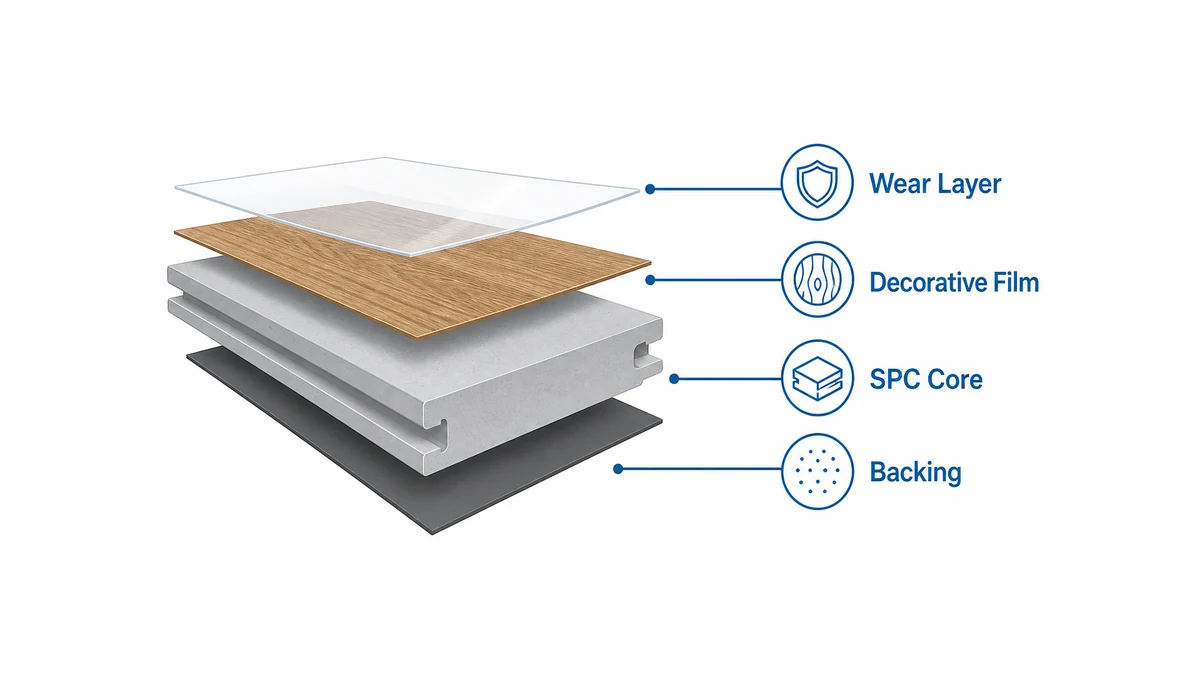
A virgin or recycled formulation can shift performance in ways a single density number hides — so the decision hinges on three variables: what the core is made of, how consistent it is, and how you verify both before you buy. Understanding the construction of rigid core SPC flooring sets the baseline for everything below.
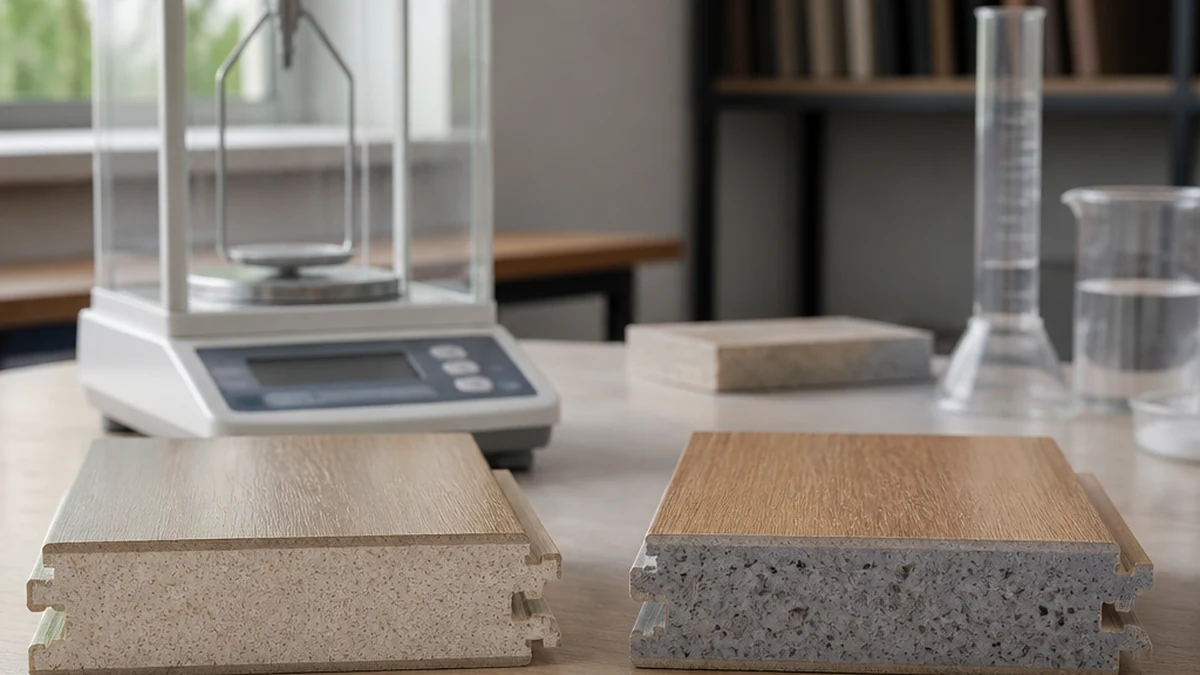
Key facts at a glance
- What density measures: mass per unit volume of the rigid SPC core alone, expressed in g/cm³ — not the whole plank.
- Typical core range: density varies with the filler ratio and formulation, so treat any single figure as approximate rather than a fixed benchmark.
- Standard test methods: ASTM D792 and ISO 1183.
- Core recipe: PVC resin, calcium carbonate filler, calcium-zinc stabilizers, plus lubricants and impact modifiers.
- Virgin vs recycled: changes formulation consistency and impact behavior more than it changes the raw density figure.
- What density does NOT prove: better formulation, better dimensional stability, or lower brittleness on its own.
What SPC Core Density Actually Tells a Buyer
SPC — stone plastic composite — gets its rigidity from a limestone-and-PVC core pressed into a hard board. Density describes how tightly packed that core is. It is a useful data point, but it sits alongside thickness, the wear layer, and the backing, not above them.
Think of density as one input into a rigid vinyl plank buying checklist, not the verdict. It tells you about the core’s compaction. It says nothing about resin quality or batch control.
How SPC core density is measured in g/cm³
Core density is measured in grams per cubic centimeter using displacement. A technician cuts a sample from the rigid core — wear layer and any attached backing removed — then weighs it in air and in water per ASTM D792 or the equivalent ISO 1183. Skipping that isolation step gives you a mixed reading, not a true core value.
Why plank weight alone does not prove higher core density
A heavier plank is not automatically a denser core. Plank weight bundles the core, the wear layer, the decorative film, and any pre-attached underlayment. A thicker board or a heavier backing can raise total weight while the core itself stays average.
Weigh the whole plank and you measure everything except the one thing you care about.
Why density comparisons need consistent test conditions
Density values are only comparable when suppliers test equivalent rigid-core specimens using the same method and comparable sample preparation. The wear layer, decorative film, and attached backing should be excluded from the specimen. Buyers should also confirm the test method, specimen condition, and reported units before comparing results from different suppliers.
Virgin vs Recycled SPC Core: What Changes in the Formulation
Formulation is the recipe behind the rigid core, and it is where virgin and recycled paths split. The visible plank looks identical either way — the difference lives in the pellets fed into the extruder.
PVC resin, calcium carbonate, stabilizers, and processing additives
A typical SPC core is built from four ingredient groups:
- PVC resin — the polymer binder that holds the core together.
- Calcium carbonate — ground limestone, the bulk mineral filler that gives SPC its stone character.
- Stabilizers — usually calcium-zinc systems that protect the resin during hot processing.
- Processing additives — lubricants and impact modifiers that control flow and toughness.
The ratio among these ingredients influences both density and performance. Increasing the proportion of mineral filler can raise core density, but the final value also depends on the rest of the formulation, porosity, and processing conditions.
Where regrind and recycled PVC can enter the core formulation
Recycled content enters in two forms. In-house regrind is trim and off-spec board reground and fed back into the line — clean and traceable when managed well. Post-consumer or post-industrial recycled PVC comes from outside the factory and carries more variability in resin grade and contamination.
Both can legitimately appear in a core. The question is how much, and how consistently.
🧨 Common failure: Accepting an unspecified “eco core” without clearly defining the recycled-material source and allowable content. Poorly controlled external recycled PVC can introduce additional batch-to-batch variability in resin composition, contamination, and processing behavior.
Why “virgin core” and “recycled core” claims need verification
You cannot see resin origin in a finished vinyl plank, which is why the “is this buyer’s guide legit?” instinct applies to supplier claims too. A “100% virgin core” label is a marketing statement until documentation and testing back it.
Have a project or a spec sheet in hand? Talk to skspcflooring — real engineers answer.
FAQ
Does a higher SPC core density always mean better flooring quality?
No. A higher density can indicate a more compact rigid core, but it does not prove that the formulation is better. Density can also rise when a manufacturer increases the proportion of calcium carbonate relative to PVC resin. If the formulation becomes too heavily filled, the core may gain rigidity while losing toughness, increasing the risk of brittle click edges or cracking. B2B buyers should therefore compare density together with resin content, filler ratio, impact performance, dimensional stability, and batch consistency rather than specifying the highest density available.
How can buyers tell whether an SPC flooring core contains recycled material?
A visual inspection can reveal warning signs, but it should not be treated as definitive proof. Buyers can cut or break a production sample and inspect the core cross-section for inconsistent color, dark particles, pores, bubbles, or unusually rough texture. A uniform cross-section generally indicates more consistent material processing, while visible contamination may justify further investigation. For purchase approval, buyers should combine sample inspection with supplier declarations, raw-material records, production traceability, and appropriate third-party testing instead of relying on appearance alone.
Can two SPC floors have the same core density but different calcium carbonate content?
Yes. Core density is influenced by more than one formulation and processing variable, including the calcium carbonate-to-PVC ratio, additive package, compaction, void content, and extrusion conditions. Two suppliers can therefore report similar density values while using different resin grades or filler proportions. This is why density should not be used as a shortcut for calculating the exact calcium carbonate content of an SPC core. Buyers that need formulation control should specify acceptable material composition separately and request supporting production or laboratory evidence.
What test data should a buyer request to verify an SPC supplier’s core-quality claim?
Start with a density result based on an appropriate plastics density method such as ASTM D792 or ISO 1183, but do not stop there. For supplier qualification or large-volume orders, buyers can also request dimensional-stability data, impact or flexural performance, production-batch records, and documentation describing the core formulation and recycled-material policy. Samples submitted for approval should be traceable to the same construction and formulation intended for mass production so that the supplier cannot validate one core and manufacture another.
Sources
[1] D792 Standard Test Methods for Density and Specific… — store.astm.org
[2] Density and Specific Gravity: ASTM D792 — samaterials.com
[3] ISO 1183-1:2019 – Plastics — Methods for determining the… — iso.org
[4] ISO 1183-1:2025(en), Plastics — Methods for determining… — iso.org
[5] D792 Standard Test Methods for Density and Specific… — store.astm.org
[6] ISO 1183-1:2019 – Methods for Non-cellular Plastic Density — blog.ansi.org
[7] SPC Flooring for B2B Buyers: A Practical Guide … — hansetile.com




