
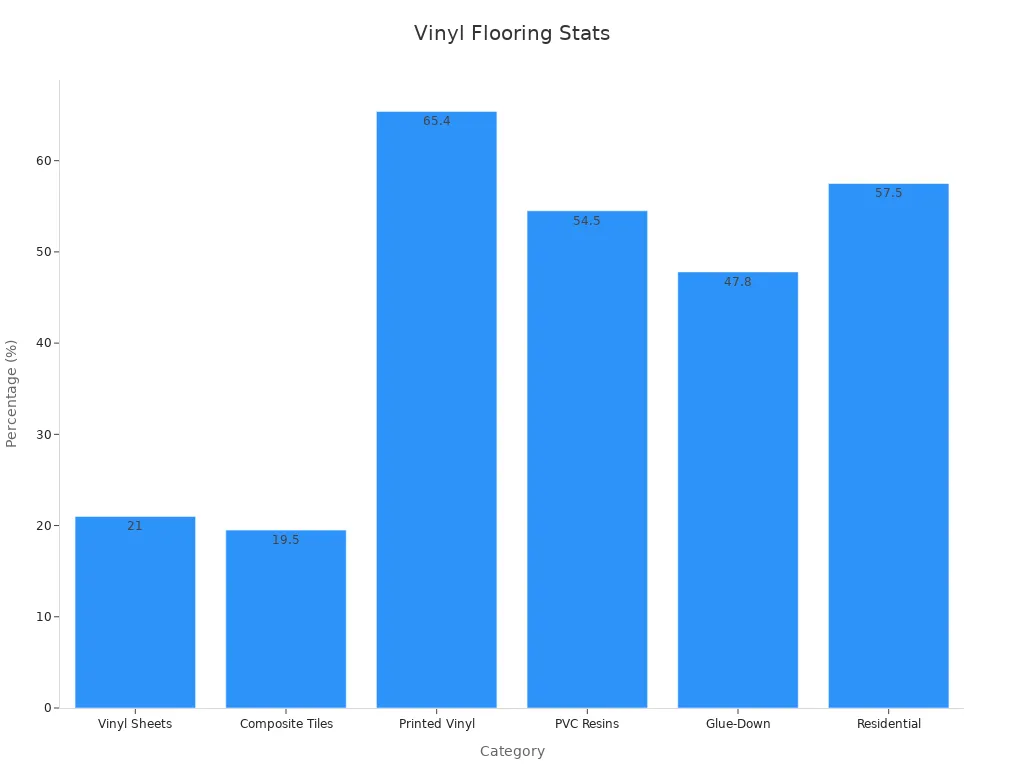
When you look for flooring that stands out in today’s market, vinyl composite flooring gives you a unique mix of strength, flexibility, and value. Many homes and businesses choose this flooring because it resists water, stains, and heavy use. The global market for vinyl flooring is growing fast, showing how much people trust its performance.
| Aspect | Statistic / Market Share | Support for Durability, Versatility, and Value |
|---|---|---|
| Global Market Size | USD 36.4B (2023) to USD 67.7B (2033) at 6.4% CAGR | Shows strong demand for durable, versatile flooring |
| Residential Use | 57.5% market share | Proves value and popularity in homes |
| Installation Type | Glue-Down: 47.8% | Trusted for high-traffic areas |
| Key Features | Water and slip resistance, shock absorbency | Fits many popular uses of vinyl composition tile |
You see vinyl composite flooring in schools, hospitals, and stores because it lasts and looks great. If you wonder what is vinyl composite flooring, think of a surface that combines practical features with style, making it a top choice for all kinds of spaces.
What Is Vinyl Composite Flooring?
Vinyl composite flooring stands out as a popular choice for both homes and businesses. When you ask, “what is vinyl composite flooring,” you discover a product designed for strength, style, and long-term use. This type of flooring uses advanced engineering and strict industry standards to deliver reliable performance in busy spaces.
Core Components and Construction of Vinyl Composition Tile
When you look at vinyl composition tile, you see a product built for durability and versatility. The main ingredients include polyvinyl chloride resin, limestone, plasticizers, and pigments. These materials come together to form a dense, resilient tile. The color and pattern run through the entire thickness of the tile, so the appearance lasts even as the surface wears.
Industry standards, such as ASTM F1066-23, set the rules for how manufacturers make vinyl composition tile. You find these tiles in standard sizes, usually 12 inches by 12 inches, and in thicknesses like 1/8 inch or 3/32 inch. The pigments resist fading from water, cleaning agents, and light, so your floors keep looking fresh.
Vinyl composite tiles meet strict fire safety and durability ratings. For example, they pass tests for static load limits and fire performance, making them safe for schools, hospitals, and stores. You can install these tiles over many types of subfloors, including concrete, terrazzo, and wood with approved underlayments. However, you should avoid areas with too much moisture or hydrostatic pressure.
Tip: Always check that your subfloor is clean, dry, and smooth before installing vinyl composition tile. This step helps your flooring last longer and look better.
You also benefit from the product’s dimensional stability and recycled content. Many vinyl composite tiles include pre-consumer recycled materials, which supports sustainability goals. The packaging usually contains about 45 tiles per carton, with the total weight depending on the thickness.
How VCT Differs from Standard Vinyl Flooring
When you compare VCT to standard vinyl flooring, you notice several important differences. VCT, or vinyl composition tile, uses a blend of limestone, plasticizers, and pigments. Standard vinyl flooring, such as sheet vinyl or luxury vinyl tile (LVT), relies more on synthetic materials like PVC.
VCT comes in square tiles that you install with adhesive. The through-color and pattern wear layer gives VCT high durability, gouge resistance, and the ability to handle heavy rolling loads. You often see VCT in places with lots of foot traffic, such as schools and retail stores. Standard vinyl flooring, like LVT, offers more design options and easier installation methods, such as click-and-lock or peel-and-stick systems.
Here’s a table to help you see the differences:
| Feature | VCT (Vinyl Composition Tile) | Standard Vinyl Flooring (LVT, Sheet Vinyl) |
|---|---|---|
| Main Materials | Limestone, plasticizers, pigments | Mostly PVC, sometimes with added layers |
| Installation | Adhesive required | Click-lock, peel-and-stick, or adhesive |
| Durability | High, handles heavy loads | Good, but varies by product |
| Maintenance | Needs regular polishing and waxing | Easier, less frequent maintenance |
| Water Resistance | Good, but seams can allow moisture | Excellent, especially in LVT and sheet vinyl |
| Comfort Underfoot | Firm | Softer, especially in LVT and WPC |
| Cost | Lower initial, higher upkeep | Moderate, with less ongoing maintenance |
| Environmental Impact | Contains recycled content | Mostly PVC, some recycled content |
You should know that VCT needs regular maintenance, such as stripping, buffing, and waxing, to keep its shine and protect the surface. Standard vinyl flooring usually needs less upkeep. VCT lasts about 15 to 20 years with proper care, while some luxury vinyl products last 10 to 15 years.
When you ask, “what is vinyl composite flooring,” you see that VCT offers a unique mix of strength, stability, and value. It meets strict standards from groups like the Resilient Floor Covering Institute and ASTM, so you can trust its quality. FloorScore® certification also ensures that many vinyl composite tiles meet indoor air quality and safety standards.
Vinyl composite flooring gives you a reliable, cost-effective solution for high-traffic areas. You get a product that balances durability, design, and environmental responsibility. Whether you choose VCT or another type of vinyl flooring, you benefit from modern engineering and proven performance.
Key Features and Benefits of VCT Tile Flooring
Durability and Wear Resistance
When you choose VCT tile flooring, you get a surface built for exceptional durability. This type of flooring stands up to heavy foot traffic every day. You can use vinyl composition tile in busy places like schools, hospitals, and stores. VCT floor tile handles heavy rolling loads and resists gouges, so you do not have to worry about damage from carts or equipment.
- VCT tile flooring is suitable for high-traffic areas.
- It is capable of handling heavy rolling loads.
- Gouge resistance adds to its durability.
- You can find VCT floor tile in many colors, shapes, and textures.
You will notice that VCT is both durable and affordable. Many commercial spaces pick VCT tile flooring because it lasts and is easy to restore. If you keep up with regular care, VCT floor tile can last 20 to 30 years. A study from Florida Hospital’s Office of Design shows that VCT offers long-term durability, but you should remember that maintenance costs can add up over time. Still, the balance between upfront strength and ongoing care makes VCT a smart choice for many.
Water and Stain Resistance
VCT tile flooring gives you strong water resistance and stability. You can trust this flooring in places where spills and moisture happen often. Vinyl composition tile does not soak up water, so it helps protect your subfloor. The surface also resists stains from common spills, making cleanup simple.
Note: While VCT floor tile offers good water resistance, you should seal seams well to prevent moisture from getting underneath.
Vinyl composite tiles keep their color and pattern, even after many cleanings. This resistance to stains and fading helps your floors look fresh for years. You can use VCT tile flooring in kitchens, hallways, and break rooms without worry.
Comfort and Underfoot Feel
You will find that VCT tile flooring feels firm underfoot. This makes it a good choice for spaces where you need a stable surface. While VCT floor tile does not feel as soft as some other vinyl options, it still provides a comfortable walking experience. You can add area rugs or mats in places where you want extra cushion.
VCT tile flooring also helps reduce noise in busy areas. The dense construction of vinyl composition tile absorbs some sound, making your space quieter. You get a floor that supports both comfort and function in your daily routine.
Vinyl Composite Flooring vs. Other Flooring Types
VCT vs. Luxury Vinyl Plank (LVP)
When you compare VCT to luxury vinyl plank (LVP), you notice several important differences. VCT stands out for its strength in high-traffic areas. You often see VCT floor tile in schools, hospitals, and busy stores. LVP, on the other hand, is popular in homes because it looks like wood and feels softer underfoot.
- VCT uses a blend of limestone and other materials, making it very dense and tough.
- LVP features a layered construction with a printed design layer that mimics wood or stone.
- VCT floor tile needs regular waxing and polishing to keep its shine, while LVP requires less maintenance.
You find that LVP offers more design choices and easier installation. Many LVP products use click-lock systems, so you can install them quickly. VCT floor tile usually needs glue and more careful preparation. Both types resist water, but LVP often performs better in wet areas because it has fewer seams.
Note: Market studies show that rigid core flooring, like SPC (a type of LVP), is growing fast. The SPC flooring market reached $13.62 billion in 2024 and could double by 2033. People choose SPC and LVP for their durability, water resistance, and easy care, especially in places where laminate or carpet may not last.
You should choose VCT if you need a floor that handles heavy loads and lots of foot traffic. LVP works well if you want a softer feel and a wide range of styles for your home.
VCT vs. Laminate Flooring
You might wonder how VCT compares to laminate flooring. Both offer affordable options, but they perform differently in real-world settings. VCT floor tile stands up to moisture and heavy use. Laminate flooring uses a fiberboard core, which can swell or warp if it gets wet.
- VCT floor tile resists water and stains, making it a good choice for kitchens, bathrooms, and basements.
- Laminate flooring looks like wood but does not handle water as well as VCT.
- You can clean VCT with a damp mop, but you must avoid too much water on laminate.
Laminate flooring installs with a click-lock system, so you can put it down quickly. VCT needs adhesive and more prep work. Laminate feels warmer and softer, but it may scratch or dent more easily than VCT.
Tip: If you need a floor for a busy, wet area, VCT gives you better protection. Laminate works best in dry rooms where you want a wood look without the cost of real hardwood.
Recent market trends show that rigid core flooring, like SPC and VCT, is gaining ground over laminate. People want floors that last longer and need less care. You see this shift in both homes and businesses.
VCT vs. Tile and Hardwood
You may also compare VCT to ceramic tile and hardwood flooring. Each type has its own strengths and weaknesses. VCT floor tile costs less to install than tile or hardwood. In 2022, resilient flooring, which includes VCT, made $9.5 billion in sales, while ceramic tile and hardwood saw smaller gains or even declines. This shows that more people choose VCT for its value and performance.
| Feature | VCT Floor Tile | Ceramic Tile | Hardwood Flooring |
|---|---|---|---|
| Initial Cost | $8–$14/sq ft | Higher | Higher |
| Durability | High | Very High | Moderate |
| Water Resistance | Good | Excellent | Low |
| Maintenance | Moderate (waxing) | Low | High |
| Comfort | Firm | Hard/Cold | Warm/Softer |
| Installation | Easier, modular | Labor-intensive | Labor-intensive |
| Lifespan | 30+ years (with care) | 30+ years | 20–30 years |
VCT floor tile resists moisture and stains, so you can use it in places where hardwood might get damaged. Hardwood needs careful upkeep and does not handle water well. Ceramic tile lasts a long time and looks great, but it can feel cold and hard underfoot. Tile also costs more to install and transport.
- VCT floor tile offers a modular design, so you can replace sections if needed.
- You can move or reinstall VCT, which is not possible with tile or hardwood.
- VCT works well in high-humidity areas, while hardwood needs climate control.
Callout: If you want a floor that balances cost, durability, and easy care, VCT gives you a smart solution. You see it used in schools, offices, and even some homes for these reasons.
You see that VCT floor tile outperforms many alternatives in cost, durability, and ease of maintenance. The growing demand for VCT and other resilient flooring types proves that more people value these benefits over traditional options.
Installation and Maintenance of Vinyl Composite Tile
Installation Methods and Ease
You can install VCT in many spaces with basic tools and a little planning. Start by reading the instructions for your VCT tile flooring. Clear the room and remove old flooring if needed. Make sure the subfloor is dry, clean, and flat. Gather a utility knife, a carpenter’s square, and a 100 lb. roller. Let the VCT and the room reach the same temperature for 48 hours before you begin.
- Lay out your VCT tiles according to the room’s shape.
- Use adhesive as directed and press each tile firmly.
- Allow for a small gap at the edges for expansion.
- After placing all tiles, roll the floor to set them in place.
- Clean up tools and avoid heavy traffic for 72 hours.
Many people find VCT installation easy, even for beginners. For large or complex rooms, you may want a professional installer. Real-world case studies show that VCT tile flooring holds up in busy shopping malls and schools, with few installation issues. If a seam splits, you can repair it quickly.
Tip: Always check the subfloor before installing VCT. A smooth base helps your flooring last longer.
Cleaning and Upkeep
VCT tile flooring stands out for its simple cleaning routine. Sweep or vacuum to remove dirt. Use a low-speed buffer and a neutral cleaner to scrub the floor. Rinse with clean water and mop. Apply a fresh coat of wax or finish to protect against moisture and foot traffic.
- Place mats at doors to keep out dirt.
- Use furniture pads to prevent scratches.
- Follow a schedule for stripping old wax and reapplying new coats.
Regular care keeps your VCT looking new. In hospitals and offices, staff report that VCT needs minimal maintenance when you follow these steps. If you want to know how to maintain VCT tile flooring, stick to these basics and use the right equipment. Without regular upkeep, VCT can show wear, so stay on top of cleaning.
Suitability for Different Rooms
VCT works well in many rooms. You see it in kitchens, hallways, and break rooms. VCT tile flooring is ideal for kitchens because it resists spills and stains. In commercial spaces, VCT covers floors in malls, hospitals, and schools. Its durability and easy installation make it a top choice for busy areas.
- Kitchens: VCT handles spills and heavy use.
- Bathrooms: Water resistance makes it a safe pick.
- Entryways: VCT stands up to dirt and foot traffic.
- Offices: Easy to clean and replace if needed.
VCT flooring remains popular in both homes and businesses. In 2022, VCT made up a strong share of the commercial flooring market. Its cost-effectiveness and wide range of colors help you match any room style. You get a floor that lasts, looks good, and needs only minimal maintenance.
Market Advantages and Real-World Value of VCT Flooring
Design Versatility and Style Options
You can choose vct tile flooring for almost any space because it offers a wide range of design options. Modern manufacturing uses digital printing to create patterns that look like wood, stone, or abstract art. You find vct in many colors and textures, so you can match your style or brand. Modular systems let you replace tiles easily, which helps during renovations or when you want a new look.
Design trend reports show that vct flooring adapts to both homes and businesses. You see it in schools, offices, gyms, and even kitchens. The flooring market overview highlights how vct tile flooring meets the demand for durable and attractive surfaces. You get waterproof, soundproof, and anti-slip features, making vct a flexible choice for many environments.
Tip: If you want a floor that looks good and lasts, vct gives you both style and function.
Cost-Effectiveness and Longevity
Vct tile flooring stands out for its affordability and long life. You spend less on installation and upkeep compared to many other flooring types. Studies show that vct lasts about 30 years with proper care. You need to strip and recoat the surface sometimes, but this helps your floor stay strong and clean.
Here is a table comparing vct with other flooring materials:
| Flooring Material | Average Lifespan (years) | Maintenance Needs | Cost-Effectiveness |
|---|---|---|---|
| Vinyl Composition Tile | 30 | Stripping and recoating needed | Least expensive |
| Linoleum | 30-40 | Frequent cleaning | Balanced |
| Ceramic Tile | 50 | Occasional sealing | Higher lifecycle cost |
| Terrazzo | 40-75 | Regular maintenance | High lifecycle cost |
You get cost-effective flooring that balances upfront price and long-term durability. Many schools and businesses pick vct because it saves money over time. The affordability of vct tile flooring makes it a smart investment for large spaces.
Environmental Impact and Sustainability
You may wonder about the environmental side of vct flooring. Life Cycle Assessments (LCA) and Environmental Product Declarations (EPDs) help you compare the impact of different floors. Vct uses some recycled content and meets many safety standards. Green building programs like LEED recognize vct tile flooring for its compliance with sustainability criteria.
Many manufacturers now focus on recycling and reducing emissions. You see efforts to lower VOCs and use more eco-friendly materials. Research shows that circular business models, such as refurbishing and reusing tiles, can reduce the environmental footprint of vct. These steps help you choose a floor that supports both your needs and the planet.
Here is a chart showing vct’s strong market share and demand in educational spaces:
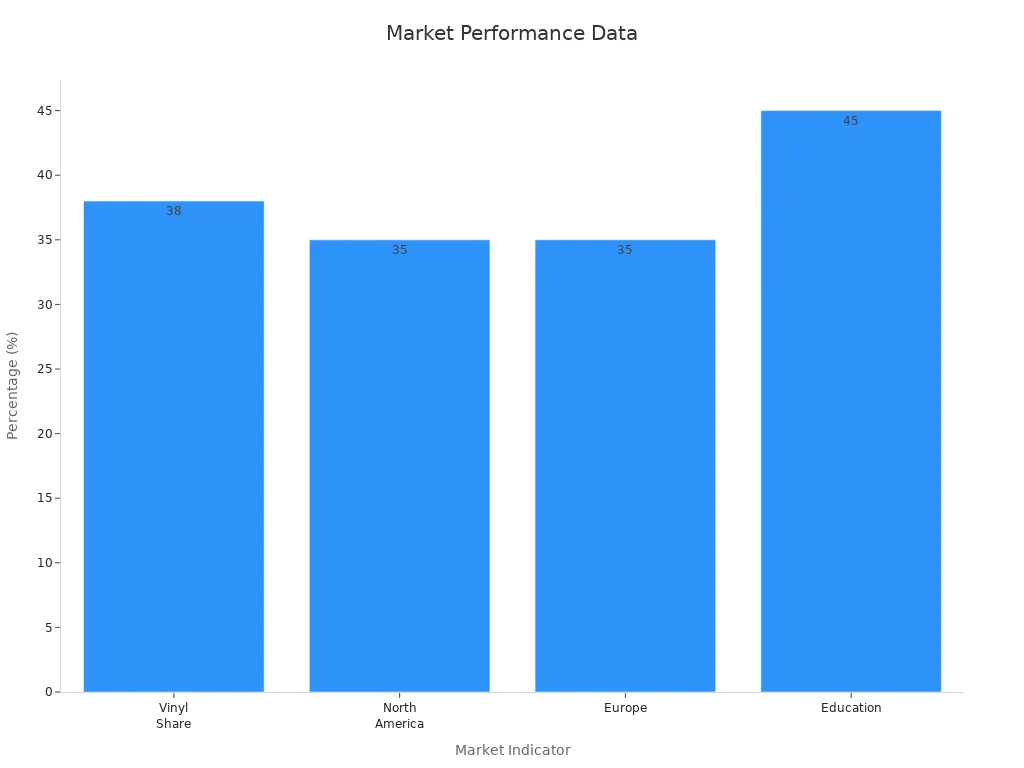
- Vct holds about 38% of the indoor sports flooring market.
- Educational institutions drive 45% of the demand for vct tile flooring.
- North America and Europe lead in market share, while Asia-Pacific grows quickly.
You see that vct flooring combines affordability, durability, and sustainability. This makes it a valuable choice for many projects.
Vinyl composite flooring gives you a smart choice for both homes and businesses. You see strong sales growth and high satisfaction because people value its realistic look, durability, and easy care. The market keeps expanding as more people choose floors that resist water and offer many design options.
- You get affordable, long-lasting floors with textures that look and feel real.
- You enjoy simple installation and low maintenance.
Consider VCT tile flooring if you want a floor that combines style, strength, and value for your next project.
FAQ
What makes vinyl composite flooring a good choice for high-traffic areas?
You get strong durability with vinyl composite flooring. It resists scratches and dents from heavy use. Many schools and hospitals use it because it lasts a long time and stays looking good.
Can you install vinyl composite tile by yourself?
Yes, you can install VCT yourself if you follow the instructions. You need a clean, flat subfloor and basic tools. Many people find the process simple, especially for small rooms.
How do you keep vinyl composite flooring clean?
You should sweep or vacuum often. Use a damp mop with a neutral cleaner. For best results, apply wax or finish as needed.
Tip: Place mats at doors to keep dirt away.
Is vinyl composite flooring safe for people with allergies?
Vinyl composite flooring does not trap dust or pollen. You can clean it easily, which helps reduce allergens in your home.
- Good for people with allergies
- Simple to keep dust-free
How long does vinyl composite flooring last?
Most VCT floors last 20 to 30 years with proper care. You can extend the life by cleaning and waxing regularly.
| Maintenance Level | Expected Lifespan |
|——————|——————-|
| High | 30 years |
| Moderate | 20 years |




