
A common and costly spec mistake in commercial flooring isn’t picking the wrong color. It’s ordering chevron planks with a thin wear layer because the price per square foot looked right, then watching the surface haze under rolling chairs within a year.
Chevron SPC Flooring for Commercial Projects: Thickness, Wear Layer & Click System decisions each pull a different lever — and conflating them is how projects go over budget on the re-order, not the first order.
This guide treats those three variables as separate levers. Thickness governs how the floor sits over your subfloor. The wear layer governs surface life under traffic. The click system governs seam integrity in a directional layout. Get the pairing right and the chevron look holds up; get it wrong and the pattern that sold the room becomes its liability.
If you’re still weighing pattern direction, our guide to SPC vinyl flooring patterns covers chevron layout and orientation separately, while the broader SPC core construction basics are worth understanding before you spec thickness.
What Makes Chevron SPC Flooring Suitable for Commercial Projects
Chevron SPC flooring pairs a cut-angle plank geometry with a rigid stone-polymer core. The combination gives you a high-end directional pattern on a substrate that resists dents, moisture, and dimensional movement better than engineered wood under the same conditions.
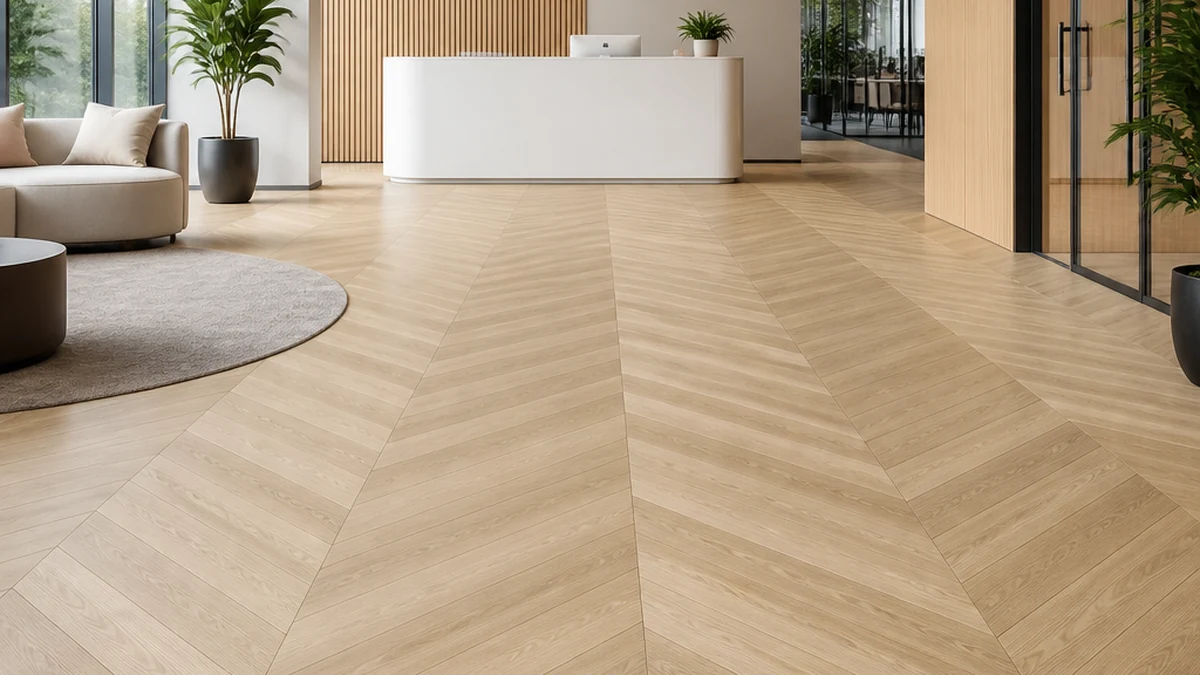
Chevron Plank Geometry and Directional Layout
Chevron planks are cut at a precise angle on each end so two planks meet point-to-point and form a continuous V-shaped seam. Unlike a straight plank, the geometry is directional — left-cut and right-cut planks are distinct SKUs that must be ordered as a matched pair.
That matters for commercial buyers in one concrete way: a chevron run has no forgiving “cut-to-fit” tolerance at the angle joint. The milling angle, usually 45 or 60 degrees, has to be consistent across every plank in the batch, or the pattern drifts across a long corridor.
🎯 Key point: Chevron is a two-SKU product. Confirm your quantity split between left-cut and right-cut planks before you order, not after delivery.
Rigid SPC Core Construction
SPC stands for stone-plastic composite — a dense, rigid core of limestone powder and PVC that gives the plank its stability. The material formulation and SPC flooring core density also influence how the rigid core performs. The rigid core is why SPC flooring stays flat over minor subfloor imperfections. A flexible vinyl would telegraph them.
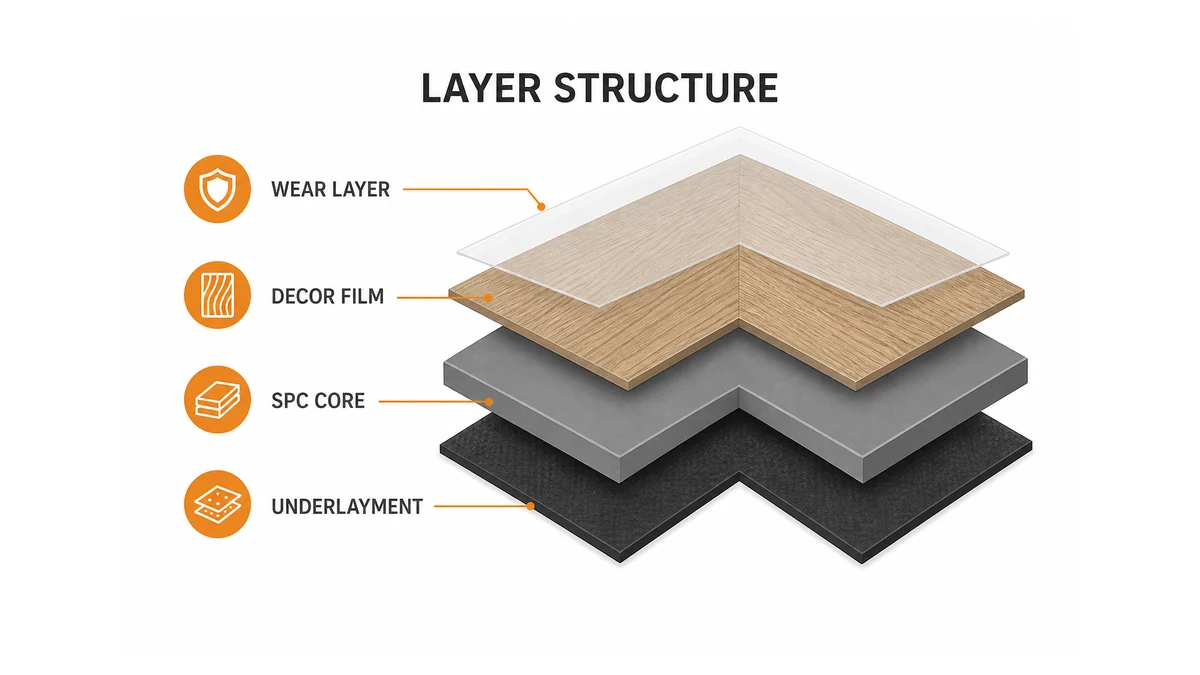
We manufacture to ISO9001, EN, and ASTM standards across our ten production lines. That line consistency is what keeps the chevron angle true from plank to plank, which matters more on a directional pattern than on any square-cut product.
A rigid core also makes the floor waterproof as a material. The core doesn’t swell when water sits on a seam — a real advantage in commercial kitchens, lobbies, and restrooms. SPC’s low moisture-driven movement is one reason the resilient-flooring category now dominates commercial resilient flooring specification[1], where polyvinyl chloride flooring[2] is a recognized standard-covered product class.
Choosing Core Thickness for Commercial Chevron SPC Flooring
Core thickness is a construction decision, not a durability guarantee. It determines how the plank interacts with your subfloor and underlayment — not how long the surface survives traffic. Treat it that way and you’ll avoid over-specifying.
Core Thickness Options for Chevron SPC Planks
Commercial chevron SPC planks typically run from 4mm to 6.5mm in total build, with the rigid core making up most of that [5]. Thicker cores add rigidity and a slightly more solid underfoot feel. They do not add surface wear resistance.
Here’s the distinction that trips people up: a 6.5mm plank with a thin wear layer will scuff faster than a 4mm plank with a thick one. Thickness buys flatness and acoustic comfort. The wear layer buys longevity.
🧨 Common failure: Specifying a 6mm core and assuming it “handles commercial traffic.” Core build and surface durability are independent — the wear layer is the traffic spec.
Thickness Selection for Different Subfloor Conditions
Match thickness to what’s underneath. Over a smooth, level concrete slab, a 4mm to 5mm plank performs well. Over an older subfloor with minor undulation, a 5mm to 6.5mm plank with an attached underlayment bridges irregularities and keeps the chevron joints from flexing.
Attached underlayment also changes acoustics — relevant in multi-tenant commercial spaces with sound-transmission requirements. A loose-lay approach is generally not advised for chevron in high-traffic commercial areas; the directional joints need the mechanical lock to stay aligned.
Selecting the Wear Layer for Commercial Durability
The wear layer is the single most important spec for commercial longevity. It’s the clear, transparent top layer that takes all the abrasion — and it’s where the price-versus-performance trade-off actually lives.
Wear Layer Thickness and Abrasion Resistance
Wear layer thickness is measured in mils (one mil = 0.001 inch) or in millimeters. Commercial-grade chevron SPC flooring commonly starts around a 0.3mm (roughly 12 mil) wear layer and runs up to about 0.55mm (around 20 mil) for heavy traffic [6]. A 20 mil wear layer is a widely referenced threshold for heavy commercial resilient flooring in NALFA LVT guidance[3].
A thicker wear layer resists scratching and abrasion for longer under the same load, and abrasion performance can be benchmarked against the ASTM D4060 Taber abrasion resistance test method coatings.
| Traffic level | Example spaces | Wear layer |
|---|---|---|
| Light commercial | Private offices, boutique retail | 0.3mm (12 mil) |
| Moderate commercial | Open-plan offices, showrooms | 0.4mm (16 mil) |
| Heavy commercial | Lobbies, hospitality corridors, busy retail | 0.5mm–0.55mm (20 mil) |
Scope the wear layer to realistic foot traffic, not an abstract “commercial” label. A downside of SPC flooring worth stating plainly: the wear layer protects the surface, but it does not make the floor dent-proof under narrow point loads. More on that below.
Wear Layer Selection for Different Traffic Levels
Commercial Chevron SPC flooring should be selected according to the intensity and type of traffic in each area, rather than using one wear layer specification throughout an entire project. Private offices and boutique retail spaces generally experience less surface wear than busy hotel corridors, reception areas, or high-traffic commercial entrances.
| Traffic Level | Typical Commercial Applications | Wear Layer to Consider |
|---|---|---|
| Light commercial | Private offices, boutique stores, meeting rooms | 0.3mm (approximately 12 mil) |
| Moderate commercial | Open-plan offices, showrooms, reception areas | 0.5mm (approximately 20 mil) |
| Heavy commercial | Busy hotel corridors, retail entrances, high-traffic lobbies | 0.5mm (approximately 20 mil), subject to verified abrasion performance and traffic conditions |
For commercial buyers, a thicker wear layer can provide additional material for gradual surface wear, but it does not automatically guarantee suitability for every heavy-traffic environment. Rolling chairs, tracked-in grit, cleaning frequency, and the manufacturer’s tested surface performance should also influence the final selection.
For SK-Floor’s Commercial Chevron SPC Flooring, the listed 0.3mm and 0.5mm wear layer options provide a starting point for matching flooring specifications to project requirements. Buyers should confirm the selected product’s abrasion performance before placing bulk orders, particularly when the same Chevron pattern will be installed across areas with different traffic levels.
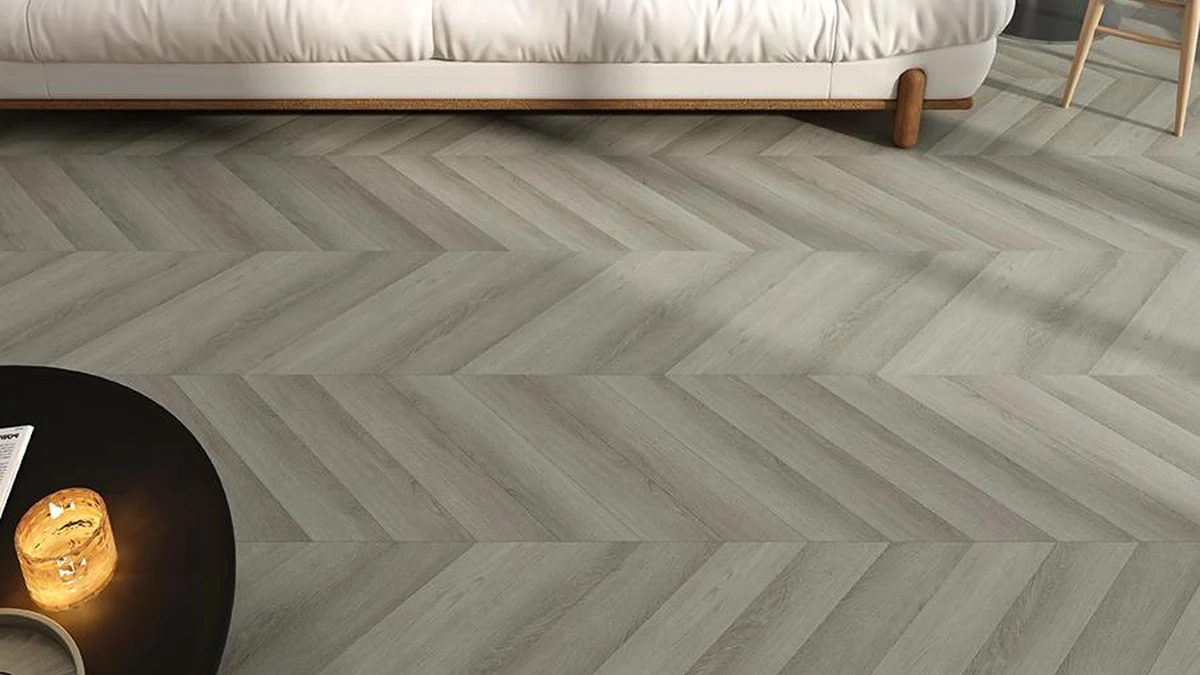
Click Lock Systems for Chevron SPC Flooring
The click system is the mechanical joint that holds planks together without glue. On a chevron floor, that joint does more work than on a straight plank — it has to keep a directional angle stable.
Directional Click Lock Joint Design
A click system on chevron flooring is an angle-and-lock or drop-lock profile milled into the plank edges. Adjacent planks snap together and resist separation. People searching “what is click system flooring” are asking about this: a glueless mechanical joint you engage by angling the plank down into its neighbor until it clicks home.
The common question — single click versus double click — comes down to the locking profile. A single click engages on one plane. A double click engages on two planes, locking both the long and short edges with firmer resistance. For chevron’s angled short joints, double-click behavior matters more than on a square-cut plank, because the directional seam carries more lateral stress during installation and in service.
🎯 Key point: On chevron, prioritize the short-edge (angle-joint) locking strength. That seam, not the long edge, is where a weak click system shows first.
Joint Strength and Seam Stability
Seam stability under commercial load is a function of locking profile precision, not marketing names. A joint that engages tightly keeps the chevron V crisp; a loose joint lets the point of the V open slightly, which is immediately visible on a directional pattern.
Not every locking profile is available on every product — confirm the click system on the SKU you’re quoting before you assume a given profile. Vinyl, laminate, and engineered-wood click systems all use related mechanical principles, but the tolerances SPC can hold differ because the rigid core machines more precisely than wood.
Commercial Performance Limitations of Chevron SPC Flooring
The limits here are about in-service conditions — loads and temperature — not the joints.
Concentrated point loads are the first limit. A rigid SPC core resists broad rolling loads well, but a heavy fixture on small feet, a loaded pallet jack wheel, or a filing cabinet corner can leave an indentation that doesn’t fully recover. For areas with concentrated static loads, use load-spreading feet or glass chair mats.
Temperature is the second. SPC expands and contracts with heat, and a floor installed in direct sunlight through a storefront window — or above a radiant heat source running hot — can move at the seams if expansion gaps weren’t respected at installation.
Keeping a floating floor within its rated service temperature matters here; many manufacturers follow general radiant heat flooring guidance[4] capping surface temperature around 27°C. In large commercial runs, that movement is cumulative across the length of a chevron pattern.
🧨 Common failure: Direct, prolonged sun on a floating SPC floor behind south-facing glass is a common cause of post-installation seam gaps. Shade the glazing or plan expansion joints into long runs.
Finally, the material is waterproof but the installation is not inherently so — standing water can still migrate under a floating floor at the perimeter. SPC resists the water; your edge detailing and subfloor still need to manage it.
Available Chevron SPC Flooring Sizes and Finishes
Chevron SPC plank sizes are typically narrower and shorter than straight planks because the pattern repeats at a smaller scale. We can supply chevron planks roughly 5 to 7 inches wide with proportioned lengths in the 24 to 36 inch range, in 4mm–6.5mm total build, and wear layers from 0.3mm to 0.55mm — the thickness×width and length combination is set per order rather than forced to a single stock size.
Milling angle (45° or 60°) and the left-/right-cut ratio are confirmed against your layout.
Surface finishes range from embossed-in-register wood textures that mimic hardwood SPC grain, to smoother matte and stone-look options. Finish affects both slip performance and perceived warmth — a matte, textured surface generally reads better underfoot in high-traffic commercial areas and hides micro-scratching better than high gloss.
Configuration options confirmed before ordering:
| Specification | Range we supply |
|---|---|
| Core thickness | 4mm–6.5mm, with/without attached underlayment |
| Wear layer | 0.3mm–0.55mm, scoped to traffic |
| Plank size | ~5–7 in wide × 24–36 in long |
| Milling angle | 45° or 60° |
| Click system | profile confirmed per SKU |
| Finish | EIR wood, matte, stone-look + color |
| Cut ratio | left-cut / right-cut split per layout |
Request Chevron SPC Flooring Specifications and a Quote
Confirming the configuration before you commit is what keeps a chevron project on budget. Decide three things first: the traffic level (which sets the wear layer), the subfloor condition (which sets core thickness), and the run geometry (which sets your click profile and left/right split).
With those settled, we’ll issue a technical data sheet confirming every spec — thickness, wear-layer tolerance held within 0.1mm batch to batch, click system, size, and finish — alongside an FOB price for your project quantity. Send your square footage, the use case, and any sound or slip requirements, and we’ll match the SKU and the left-/right-cut ratio to your layout so the pattern lands clean on the first order.
Have a project or a spec sheet in hand? Talk to skspcflooring — real engineers answer.
FAQ
Do Chevron SPC flooring orders need equal quantities of left and right planks?
Most standard Chevron layouts use matching left-hand and right-hand planks to create the continuous V-shaped pattern. Buyers should confirm how the manufacturer packs these paired planks and whether the project layout requires any adjustments to the quantities. The correct balance helps prevent material shortages and installation delays on commercial projects.
How much extra Chevron SPC flooring should be ordered for installation waste?
Chevron flooring generally requires additional material for perimeter cuts and pattern alignment. However, there is no fixed waste percentage suitable for every commercial project. The required allowance depends on room geometry, corridor layouts, installation direction, and the number of angled cuts. Buyers should calculate the order quantity from the approved floor plan and include a reasonable reserve for future repairs.
What is the difference between 45-degree and 60-degree Chevron SPC flooring?
The angle changes the appearance and proportions of the finished V-shaped pattern. A 45-degree Chevron layout creates a sharper, narrower V, while a 60-degree layout produces a wider, more open appearance. Commercial buyers should confirm the actual cutting angle available for their selected product and approve a physical sample before ordering large quantities.
Can Chevron SPC flooring be reordered later with the same color and pattern?
Matching replacement planks may be available, but an identical appearance cannot be assumed across different production batches. Changes in decorative film, embossing, surface finish, or production batch can create visible differences. For commercial projects, buyers should retain the approved product specifications and color reference, and consider ordering spare planks from the original batch.
Sources
[1] Resilient Flooring Market Size, Share, Growth Report, 2034 — fortunebusinessinsights.com
[2] ASTM-F1700, 2018 — secure.madcad.com
[3] LVT (Luxury Vinyl Tile) Wear Layer Thickness — msisurfaces.com
[4] Designing and Installing Radiant Floors with the 2019 … — hardwoodfloorsmag.com
[5] SPC Flooring Spec Sheet — img.shop.az-reko.cz
[6] What’s up with the wear layer on vinyl plank flooring? — reddit.com
[7] Resilient Floor Covering Standards – Standards Products — store.astm.org




